

Online casinos use terms such as fairness, RTP, odds, and Provably Fair constantly. The problem is that these concepts are often presented together even though they answer very different questions.
A casino game can be completely transparent and still have relatively expensive odds. Likewise, a game can advertise a low mathematical edge without giving players any meaningful way to verify how individual results are generated.
Understanding the difference between house edge and Provably Fair verification is therefore one of the most useful things a casino player can learn.
House Edge Measures the Casino’s Mathematical Advantage
Every casino game needs a mathematical structure that gives the operator an advantage over time.
That advantage is known as the house edge.
A game with a 2% house edge does not mean a player automatically loses 2% of every bet. Individual sessions can produce large wins or losses because short-term results are driven by variance.
Instead, the percentage represents the casino’s theoretical advantage across a very large number of wagers.
For example, a 3% house edge corresponds to a theoretical return of roughly 97% over the long term.
This makes house edge particularly useful when comparing similar games.
Two roulette-style games can look almost identical while operating with different mathematical margins. Over thousands of wagers, even a relatively small difference can become significant.
The same principle applies to newer gambling formats such as crash, mines, case opening, and skin-based games. Players interested in how these margins work in practice can find a more detailed breakdown in this guide to understanding house edge in CS2 gambling.
Provably Fair Answers a Different Question
Provably Fair technology is primarily associated with crypto casinos and skin-gambling platforms.
Instead of telling players how favorable the odds are, it addresses whether an individual game result can be independently verified.
A typical system uses cryptographic information such as a server seed, client seed, hash, and nonce.
Before the wager is resolved, the casino commits to information used to generate the outcome. Afterward, the underlying data can be revealed and checked against the original commitment.
The objective is simple: the casino should not be able to secretly change a result after the bet has been placed.
For anyone unfamiliar with the underlying process, this explanation of how Provably Fair verification works provides a practical example of how seeds and hashes can be used to audit casino-style games.
A Provably Fair Game Can Still Have a High House Edge
This is where players often confuse the two concepts.
Provably Fair does not mean favorable odds.
Imagine a game where the casino correctly generates every result, makes the verification data available, and never changes an outcome.
That game could still carry a 10% house edge.
The game would be verifiably fair in terms of result generation, but mathematically expensive to play.
Likewise, a casino could advertise a game with a relatively low house edge while providing very little transparency about how its random outcomes are generated.
These are separate characteristics.
Provably Fair asks:
Was the outcome generated according to the stated process?
House edge asks:
What mathematical advantage does the casino have?
A serious comparison needs to consider both.
RTP Tells the Same Story From the Other Direction
Traditional online casinos often display RTP, or Return to Player, rather than house edge.
RTP expresses the theoretical percentage of wagers returned to players over the long run.
When the figures are calculated on the same basis, a game with a 96% RTP effectively carries a 4% house edge.
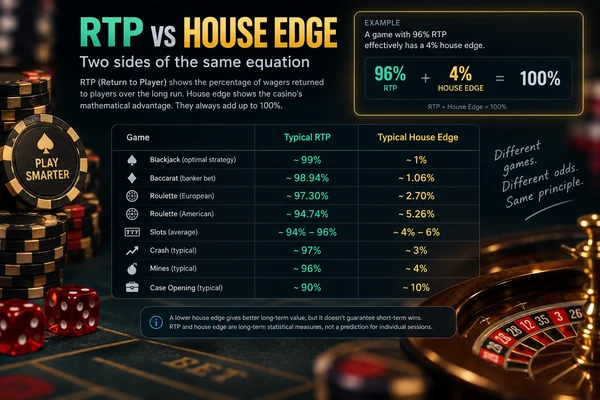
This does not mean a player depositing $100 should expect to leave with exactly $96.
RTP is a long-term statistical measure, not a prediction for an individual session.
A player could lose the entire balance quickly or finish significantly ahead. The mathematical percentage becomes meaningful across very large numbers of rounds.
That distinction is particularly important with high-volatility games.
Transparency Is More Valuable Than Marketing Claims
Casino promotions naturally focus on the most attractive numbers.
A 200% welcome bonus is easier to advertise than a detailed explanation of game mathematics.
But players evaluating a casino should also be able to find basic information about:
- RTP or house edge
- Game rules and probabilities
- Fairness verification
- Bonus wagering requirements
- Withdrawal restrictions
- KYC requirements
- Licensing and ownership
No single factor proves that a casino is trustworthy.
A license provides regulatory context but does not automatically mean every game offers competitive odds. Provably Fair technology can verify outcomes but says nothing about withdrawal quality. A low house edge provides better mathematical value but does not establish the reliability of the operator.
The strongest platforms make several of these factors transparent at the same time.
Why Crypto and Skin Casinos Put More Focus on Verification
Provably Fair systems became especially prominent in crypto gambling because blockchain-oriented users were already familiar with cryptographic verification.
CS2 skin gambling developed along a similar path.
Platforms offering roulette, crash, case battles, mines, and other proprietary games often control both the game mechanics and the gambling interface themselves. Allowing users to verify outcomes helps reduce the amount of blind trust required.
This does not eliminate gambling risk.
Players can still lose because the casino retains a mathematical advantage. But transparency makes it possible to separate two very different questions: whether the game operates as described and whether its odds provide reasonable value.
The Best Casino Information Is Information You Can Check
Casino players do not need to understand advanced mathematics or cryptography to make better comparisons.
They simply need to recognize what each metric actually proves.
House edge and RTP reveal the underlying mathematical cost of playing.
Provably Fair technology provides a method for auditing how certain game results are generated.
Neither guarantees winnings, and neither can establish the overall quality of a casino on its own.
But when a platform openly explains its odds, provides verifiable game results, clearly states its withdrawal rules, and identifies the company behind the service, players have considerably more information on which to base a decision.
That is ultimately what casino transparency should provide: less reliance on marketing claims and more information that can actually be checked.
